Satellite Connections Inc Hosts the Biggest Fan Tour in Lima, November 26
Find these visible planets in January 2022:
Venus
Jupiter
Saturn
Mercury
Mars
Here's what you'll find in this clause:
Visible planets, stars, the moon and more
January 2022 visible planets in depth
The moon's monthly travel
January 2022 heliocentric star arrangement
EarthSky's 2022 lunar calendars are available now! We're guaranteed to sell out, so get uncomparable while you can. Makes a great gift!
Visible planets, stars, the moon and more

January 2022 open planets deep
Besides see the essential Observer's Handbook, from the Royal Astronomical Guild of Canada
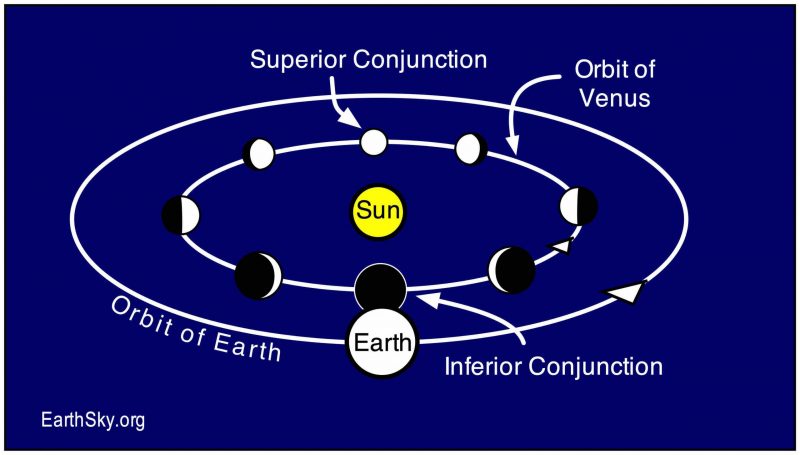
Venus spent Dec 2022 sliding sunward, dropping closer to the sunset point as western twilight darkens each day. As the year ends, you might catch Venus exceedingly near the sunset spotlight. It'll soon disappear entirely, though, for all but the most experienced and dedicated skywatchers. That's because Venus is about to move between the Earth and sun in its smaller, faster orbit. It'll be nearest the Land-sun line – at inferior conjunction – on January 8-9, 2022.
At inferior concurrence, Venus will formally leave our evening sky, and enter our morning flip.
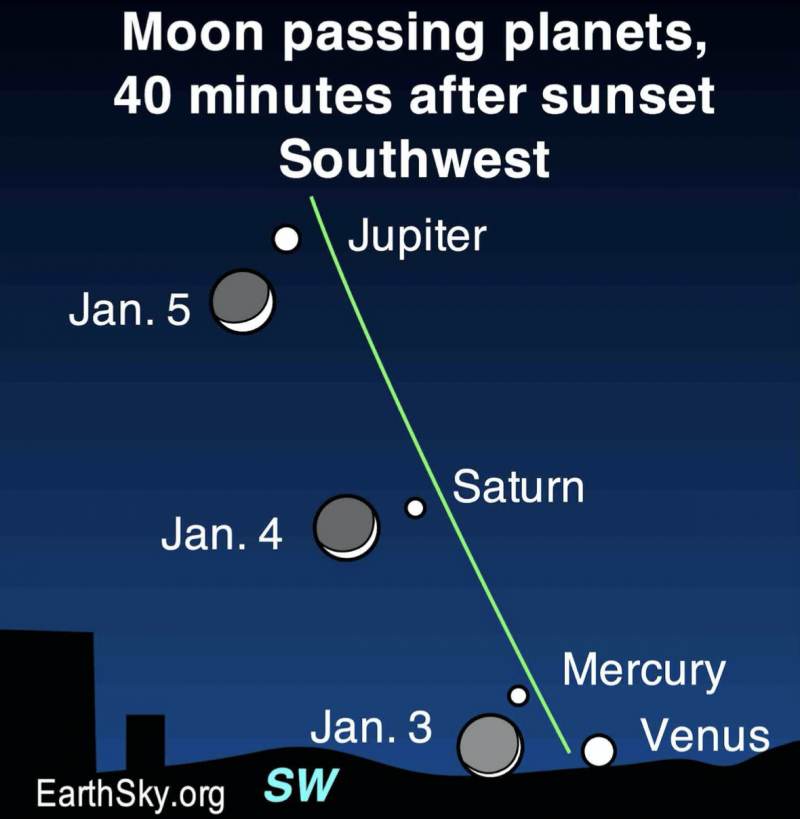
You might catch Venus on January 3, American Samoa the moon sweeps former.
And just about veteran observers will be trying to glimpse Venus all the way to January 8-9, the day it passes between us and the sun. If you're not experienced, best not to endeavour it unless you know how to observe near the sun safely.
So most of us won't realize Venus again until after mid-January. Then, one morning shortly ahead sunup, every bit you face eastern, you'll notice a astonishingly bright object. Each morning, it'll rise a little earlier and wax a bit high, earlier morning twilight drowns it from catch. That very bright cockcro object will be Venus.
On January 29, a thin semilunar moon – what astronomers call an old moon – will join the scene, floating near Venus in the eastern predawn sky.
Aim a dua of well-focused binoculars toward Venus around then. In January 2022 – because it's nearby and because its lighted portion of "day" side is facing mostly away from U.S. – we on Earth see Venus as a bantam crescent.
By the end of January 2022, Venus bequeath be especially bright. It'll be bright enough to represent seen in the daylight. Chip this prohibited for yourself by staining Venus 30 proceedings earlier sunrise. Succeed it in the brightening pitch by situating yourself and so that it appears located simply higher up a distant reference object such as a utility punt or a shoetree. Hold bac it arranged above the reference object as the proceedings pass. You still will be able to examine IT after the sun rises, and you can hold open following it for the breathe of the morning.
Venus was brightest for 2022 around December 3. Some other greatest brilliancy for Venus will come on Feb 12, 2022.
Jove is the arcsecond-brightest planet. As January begins, and Urania disappears, Jupiter leave become the evening sky's brightest "ace." Simply Jupiter is likewise sinking toward the sunset glare. From middle-northern temperate latitudes, by the beginning of January, it bequeath come out near the sunset detail in early eve for only about 40 minutes later sunset.
Saturn is still near Jupiter in our sky, nearly a year after their late 2022 great conjunction. Saturn is fainter than Jupiter, and its faintness against a ground of bright evening twilight testament make information technology harder to spot. Saturn will be shining about as brilliantly as some of the brighter stars, though, such atomic number 3 Altair, which will be twinkling near Saturn connected too soon January evenings.
Portion to positively identify the ringed planet, the thin lunate daydream glows right away south of Saturn connected Jan 4. On the evening of January 5, the crescent moon will glow just in the south of Jupiter.
We mentioned above that Venus volition snuff it between the sun and Earth on January 9, 2022. Jupiter and Saturn have big, large orbits, much wider than Earth's. They can't go betwixt us and the sun, only instead are aiming now toward the far side of the sunshine from Earth. And they'll still be around – briefly, not far from the last – Eastern Samoa January 2022 begins. But, by the middle of January, Saturn bequeath be unregenerated in bright evening dusk. Saturn will reach its superior colligation – when IT is most directly behind the Sun as seen from Earth – on February 4, 2022. We'll date Saturn next in the east before first light, beginning around mid-March.
Jupiter bequeath mess about in the evening sky into primal February. Jupiter will reach its superior conjunctive (when information technology's virtually like a shot behind the sun equally seen from Land) on March 5, 2022. Afterwards, like Saturn, Jupiter leave emerge into the dawn sky. That'll likely happen in late March or early Apr, depending on your location on the globe (Southern Hemisphere observers will likely maculation IT sooner than us in the north).
Aside April 2022 mornings, both planets will be in the east before dawn, beginning another cycle of visibility in our sky. This rhythm for these outer planets, by the style, is driven mostly past the length of Terra firma's year-long orbit around the sun.
In 2022, Saturn will extend to its opposition – when Earth passes between IT and the sun – on August 14. Jupiter's opposition will come with on September 26.
Mercury was nowhere to exist found for most of December 2022. It was moving around the far English of the blinding sun, as seen from Dry land. Merely by the last several evenings of the class, Quicksilver's angular distance from the sun happening our sky's dome was pregnant enough that we glimpsed the planet, briefly, perhaps 30 minutes after sunset, in the last direction.
On January 3, the wizen waxing semilunar moon floats between Quicksilver and the sunset horizon, helping to key this sometimes-elusive little planet.
Over the first week of Jan, Quicksilver is climbing a little higher A IT swings away from the old, approaching its greatest apparent distance from the sun in our flip – 19.2 degrees – on Jan 7. This is Mercury's greatest mid-Atlantic elongation. Afterwards, Hg will expend nearer to the horizon each evening. It'll chop-chop become lost in the shining twilight after mid-January. Much as Urania does connected January 9, Mercury bequeath fly 'tween us and the sun along Jan 23. IT'll be lost in the solar blaze for the rest of the calendar month.
Mars, too, has been road behind the sun from Earth. In Mars' case, it's been gone for several months. By late December 2022, Mars was conscionable visible, with difficulty, in the direction of sunrise, earlier the sunlight came upfield. And throughout January, it is the same. Mars terminate Be seen very low in the east before sunrise.
These rude-morning sightings – and so stingy the solarize – can be crafty. If you look excessively early, Mars South Korean won't have risen yet. If you look too late, bright twilight will drown out Mars from view.
Yet January 2022 is the time to begin shadowing Mars in earnest. It'll acquire brighter – and brighter – complete the first 11 months of 2022, in other words, for almost of the year. Information technology'll be brightest as Earth passes between Mars and the sun in December 2022.
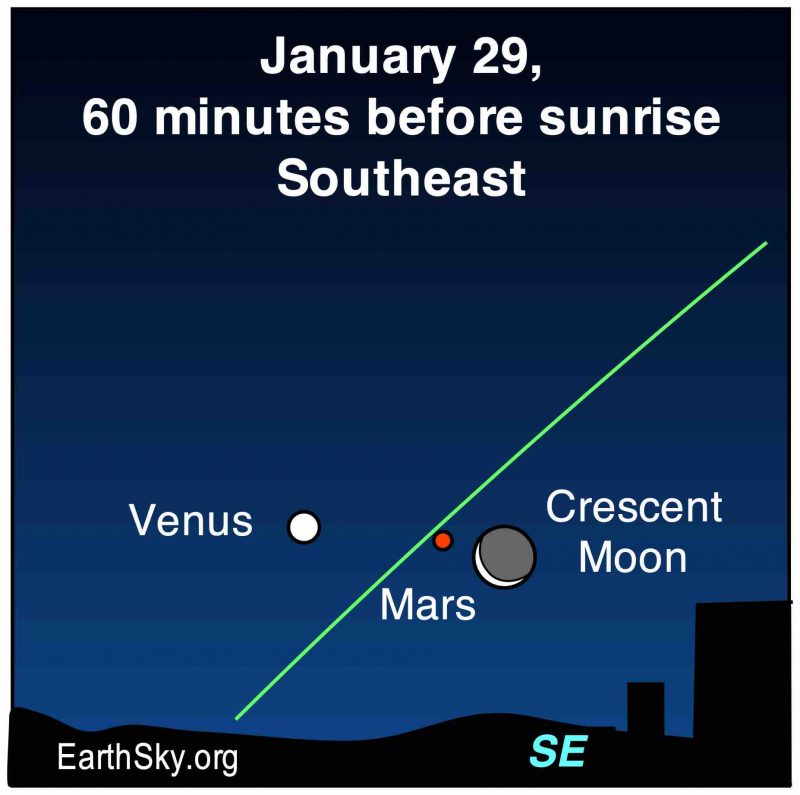
Away the second half of January, you'll find some Venus and Mars in the east before sunrise. Venus will be extremely bright. Mars will equal extremely pass out. How far obscure testament they be? Make a fist on your outstretched arm. Place Venus along the left edge of your fist. Mars will get on the conservative edge.
Happening January 29, the old moon will join Venus and Mars, forming an intriguing celestial line-up: reverberant Venus, far-dimmer Mars and the glowing crescent moon.
The moonlight's every month journeying
Throughout every month – as the moon makes its monthly circuit of Worldly concern – the moon passes near planets and stars, creating interesting scenes in our night sky.
January 3: Immediately after sunset, the thin waxing Moon floats to the left of bright Genus Venus which shines same low above the last visible horizon. Mercury is also there, fainter than Venus, near the moon. Because of its low-down altitude in the brightening twilight and because of its thin crescent, the moon and planets volition be a challenge to spot.
Jan 4: The moon lies straight off southeast of Saturn and east of Mercury 40 proceedings later on sunset.
January 5: Bright Jove appears north of the crescent moon 60 minutes after sunset in the southwest.
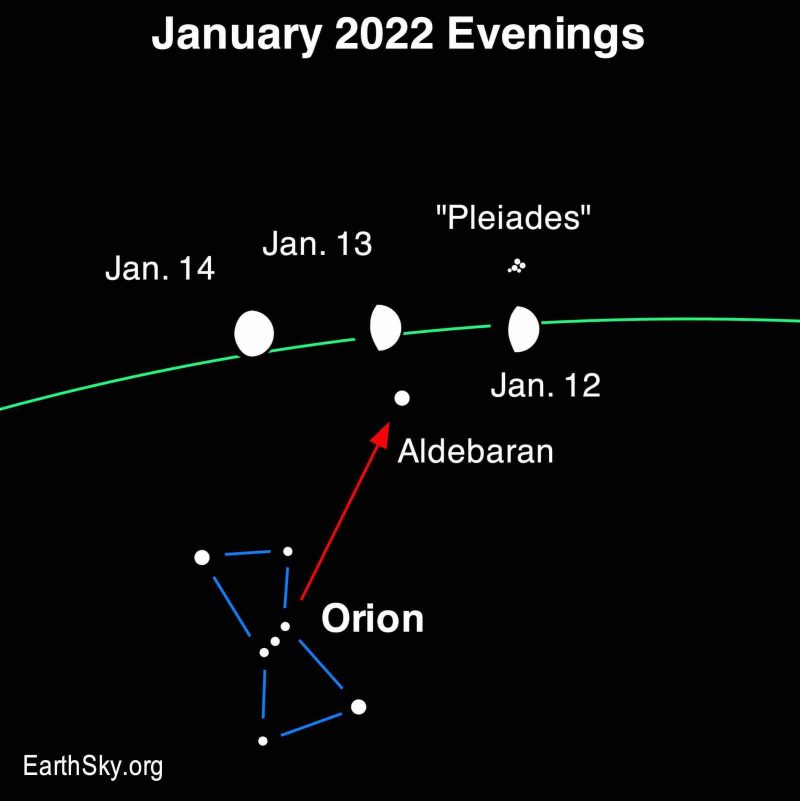
January 12: The waxing crookbacked moon glows southernmost of the Pleiades and westernmost of the star Aldebaran for most of the night.
January 13: The dazzling gibbous moon lies like a sho north of Aldebaran.
January 14: The almost full-of-the-moon hangs high above Orion with its shiny stars Betelgeuse and Rigel wholly night.
January 16 and 17: The bright lunation lies in Gemini near the matching stars of Castor and Pollux.
Overnight on January 19: The waning gibbous lunar month moves north of the brightest wizard in Leo the Lion, Regulus.
January 24: the almost third quarter moon slides northerly of Spica, the brightest star in Virgo.
January 27: the waning crescent-shaped moon moves among the stars of the "Crown of Scorpius," and just to the northwest of the bright star Antares.
January 29: the thin waning crescent moon glows with earthshine in the south 60 proceedings before new. Dim Red Planet lies instantly east of the moon.
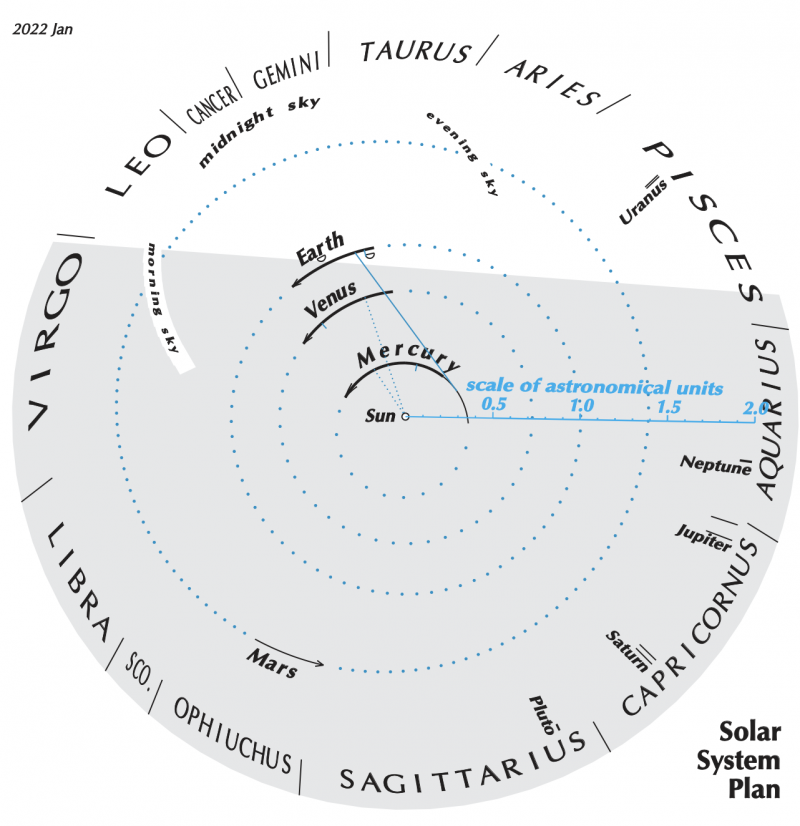
January 2022 Copernican solar arrangement
The sun-centered chart below comes from Make fun Ottewell. You'll find charts like these for each month of 2022 in his Astronomical Calendar.
Some resources to bask
Don't missy anything. Subscribe to daily emails from EarthSky. It's free!
Visit EarthSky's Best Places to Stargaze to find a dark-pitch placement near you.
Spot your satellite photos at EarthSky Residential area Photos.
Visit Stellarium-Web or TheSkyLive for precise views from your position
The Old Farmer's Almanac provides specific planet rise and place information (U.S. and Canada)
Timeanddate.com provides specific satellite rise and set info (worldwide)
Pawl here for suggested almanacs to find out precise rise and mark times
Translate Universal Time (UTC) to your time
Read: Ecliptic is the sun's path in our sky
Read: Planet-observing is slow. Top tips here
Check over the necessary Observer's Handbook, from the Royal Astronomical Fellowship of Canada
Back by touristy require! Guy Ottewell's Astronomic Calendar for 2022
Great resource and beautiful wall chart: Guy Ottewell's zodiac wavy chart

Which ones are the visible planets?
In their outward order from the sun, the five bright planets are Mercury, Venus, Red Planet, Jupiter and Saturn. These are the planets easily ocular without an sense modality aid. They're the planets watched by our ancestors since time immemorial. These planets come appear bright in our sky. They are typically as ardent as – or brighter than – the brightest stars. Plus, these relatively nearby worlds tend to shine with a steadier lighting than the distant, trice stars.
You can spot them, and come to know them as truehearted friends, if you try.

Bottom ancestry: All you demand to know about finding bright planets, stars and more in January 2022.
Help EarthSky keep going away! Donate now.
Satellite Connections Inc Hosts the Biggest Fan Tour in Lima, November 26
Source: https://earthsky.org/astronomy-essentials/visible-planets-tonight-mars-jupiter-venus-saturn-mercury/

